
Claimed or Forgotten Microcredentials?
Why Awareness is the Missing Link

Last week, I wrote about invisible microcredentials—those being earned as part of larger courses without learners even realising it. The article struck a chord, with the comments including some great real-world examples that highlight what happens when microcredentials are effectively communicated… and what happens when they’re not.

Microcredentials That Go Unnoticed
Noah Geisel, shared one example from the Los Angeles Unified School District back in 2014. They issued tens of thousands of badges—an impressive scale! But the claim rates? Single digits. Share rates? Almost zero. Most students weren’t even aware they had earned a credential. It was a great case study in large-scale issuance, but it also proved an important point: if people don’t understand what they’ve earned, why it matters, or how to use it, uptake will be minimal.
On the flip side, Noah said that when programs actively promote credentials and explain their value, claim rates can exceed 90%. That’s a stark contrast.
Ryan Greives backed this up with research from Accredible: In a survey of over 1,000 learners, 96% said digital credentials were valuable for their careers, and 78% believed they improved their job prospects. The demand is there. But too often, the link between earning and recognition is broken. (2024 State of Credentialling Report)
Rick Stoddart, made another key point—awareness is a shared responsibility. It’s not just up to the issuer. Every stakeholder in the learning ecosystem plays a role in communicating and advocating for microcredentials. But often, it’s seen as just another task—an “add-on” rather than an integral part of the learner experience.
The Change Challenge
Most discussions around microcredentials focus on technology and learning models, but the real challenge is change. We’re asking multiple stakeholders to shift their thinking and behaviour:
Learners are expected to understand how to use smaller, more granular credentials as evidence of their skills—despite traditional resumes and job applications not always having a clear place for them.
Employers are being asked to look beyond traditional trust markers like degrees and evaluate skills differently.
Educators and credential issuers need to rethink learning—not as rigid, pre-packaged courses but as more flexible, just-in-time, and skills-focused experiences.
This isn’t just a new type of qualification—it’s a different way of recognising and applying learning. And if key players don’t see the value, they won’t engage with it.
The Opportunity Gap
At the recent Digital Credential Summit, Clay Long from SHRM Foundation spoke about the growing shift toward skills-based hiring. He focused on STARs—people Skilled Through Alternative Routes. These are individuals who have work experience and valuable skills but lack the formal degree credentials that many employers still use as hiring filters.
The numbers are staggering. Research from December 2020 found that 30 million STARs in the U.S. already have the skills to earn 70% more than their current wages. But here’s the problem: when they switch jobs, they often move into roles with the same or even lower pay. Why? Because they don’t have evidence of their skills. They lack recognised proof.
Australia has a similar challenge—around 29% of the workforce has no post-school qualification. That’s millions of skilled workers whose potential is being held back simply because they can’t easily prove what they know and can do.
Barriers to Adoption
If microcredentials are going to help to close this gap, we need to address why they’re not being fully embraced. Here are five key barriers:
1. Lack of Communication
Many credentialing programs fail at the most basic step:
Learners don’t know they’ve earned a credential.
They don’t know what it means.
They don’t know how to use it.
They don’t know how to talk about it.
One case study found that learners who received microcredentials with rich skill descriptors reported much higher confidence in job interviews. They weren’t just given a badge—they were given the language to describe their skills.
✅ Solution: Stop treating credential communication as a separate task. Instead, embed it into every learner touchpoint—from course introductions to career services.
2. The Claiming Process is Confusing or Hidden
If credentials suddenly appear in a learner’s inbox with no context, they’re easy to ignore. I recently had a discussion about whether a small charge for microcredentials might increase their perceived value. While I’m still considering that idea, there’s something to be said for effort and recognition—if learners don’t know why or how they received a credential or what it represents, they’re less likely to value it.
✅ Solution: Even if a microcredential is awarded automatically (e.g., for completing existing learning), make sure learners understand:
What it represents
Why they received it
How they can use it
3. Lack of Employer Engagement
Microcredentials can’t just be an academic exercise—they need real-world recognition. Universities like the University of Phoenix are excelling at this by co-designing credentials with industry to solve local skill shortages. And the emphasis here is local - not every microcredential needs global recognition. If there’s a shortage of aged care workers in your region, creating microcredentials tailored to that gap is incredibly valuable—even if it’s only relevant to local employers.
✅ Solution: Stop designing credentials in isolation. Bring industry partners into the conversation from the start and find out what is relevant in your community, your region or your specific industry.
4. Faculty and Approver Disconnect
If faculty and administrators see microcredentials as an “extra task,” they won’t engage with them. Worse, if they’re completely removed from the process (e.g., if microcredentials are awarded automatically without their involvement), they miss the chance to become advocates.
✅ Solution: Integrate microcredentials seamlessly into existing workflows so they’re not a burden but a natural part of the learner journey and all stakeholders understand their value. One tip is to use microcredentials with your own staff for their professional development to raise their awareness and understanding.
5. No Incentive to Share Credentials
Even when learners do claim microcredentials, they often don’t share them. The reason? They don’t see an immediate payoff.
✅ Solution: Show them how and where to share. Provide:
Step-by-step guides for adding them to LinkedIn.
E-portfolio templates.
Job application guides.
Interview tips on how to talk about their credentials and what skills and knowledge they represent.
If learners start using microcredentials effectively, employers will take notice. This creates a positive feedback loop—more learners share, more employers recognise, and more value is created.
The Bottom Line
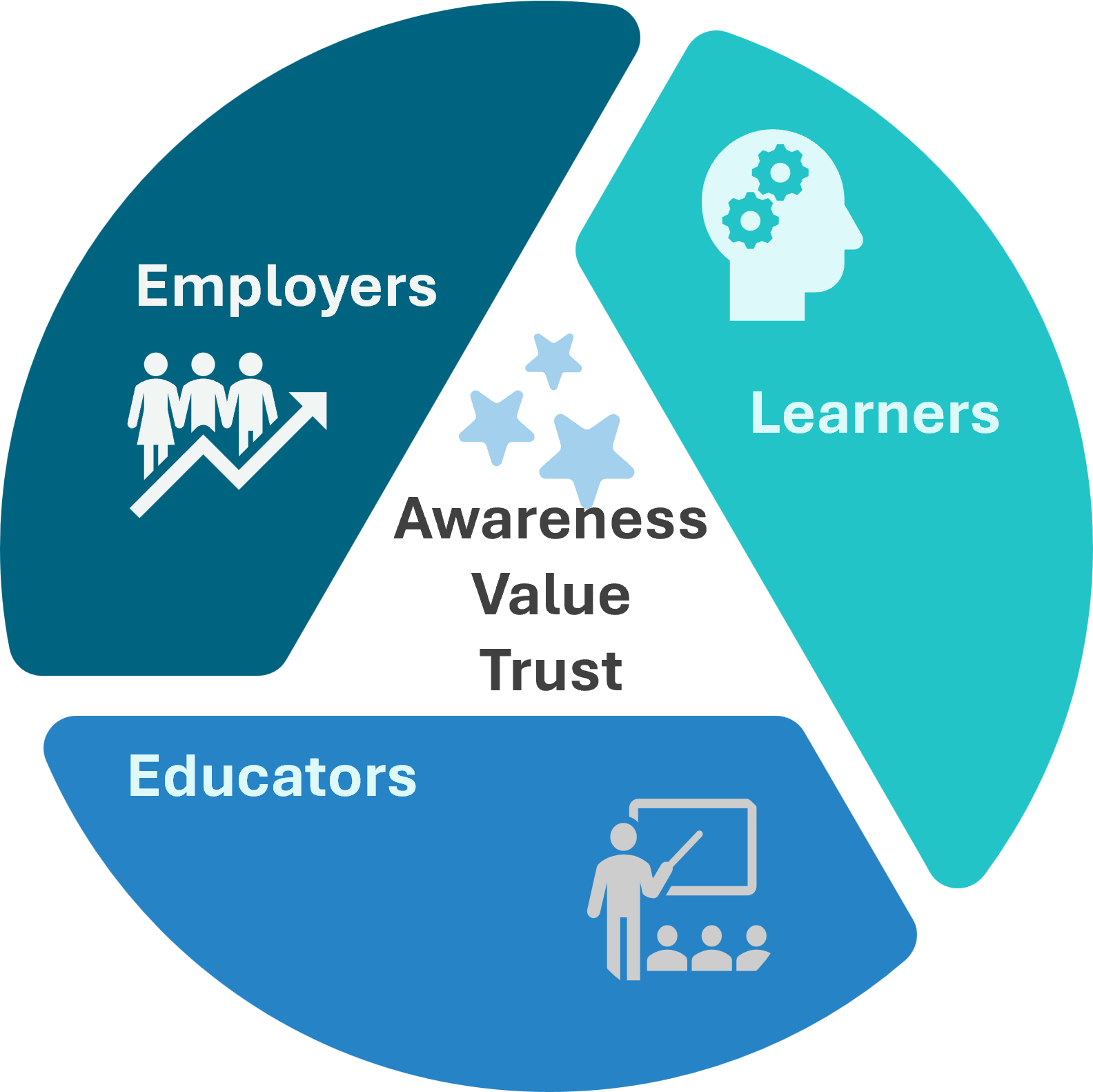
Awareness isn’t just a marketing challenge—it’s a core part of whether microcredentials succeed or fail. It should be built into every stage of the credentialing process:
Learners should know exactly what they’re earning.
Employers should understand why these credentials matter.
Educators should design them with demand, not just supply, in mind.
So, here’s my question to you: What’s one change you can make today to increase awareness in your credentialing program?
If your organisation is struggling with this, I use learner experience mapping as a tool to uncover gaps in communication and engagement. It helps identify where we can embed awareness so that credentials aren’t just issued—they’re understood, valued, and used, contact me if you would like to explore further.
Let’s move from forgotten to fully recognised.
Next week I’ll be exploring more around Learner Agency and the consumption of credentials.