
Designing Microcredentials
A Learner-Centred Approach to the End-to-End Experience

In today's rapidly evolving educational landscape, microcredentials have emerged as more than just a passing trend—they represent a vital complement to traditional education. While degrees and traditional certifications remain valuable, microcredentials offer a flexible way to recognise and validate learning that occurs outside conventional academic settings. These compact, focused credentials are increasingly becoming essential tools in addressing the dynamic needs of learners, employers, and educational institutions. However, launching a successful microcredential program requires more than simply creating a course and issuing a digital badge. The key lies in designing a comprehensive experience that puts the learner at the centre of every decision.
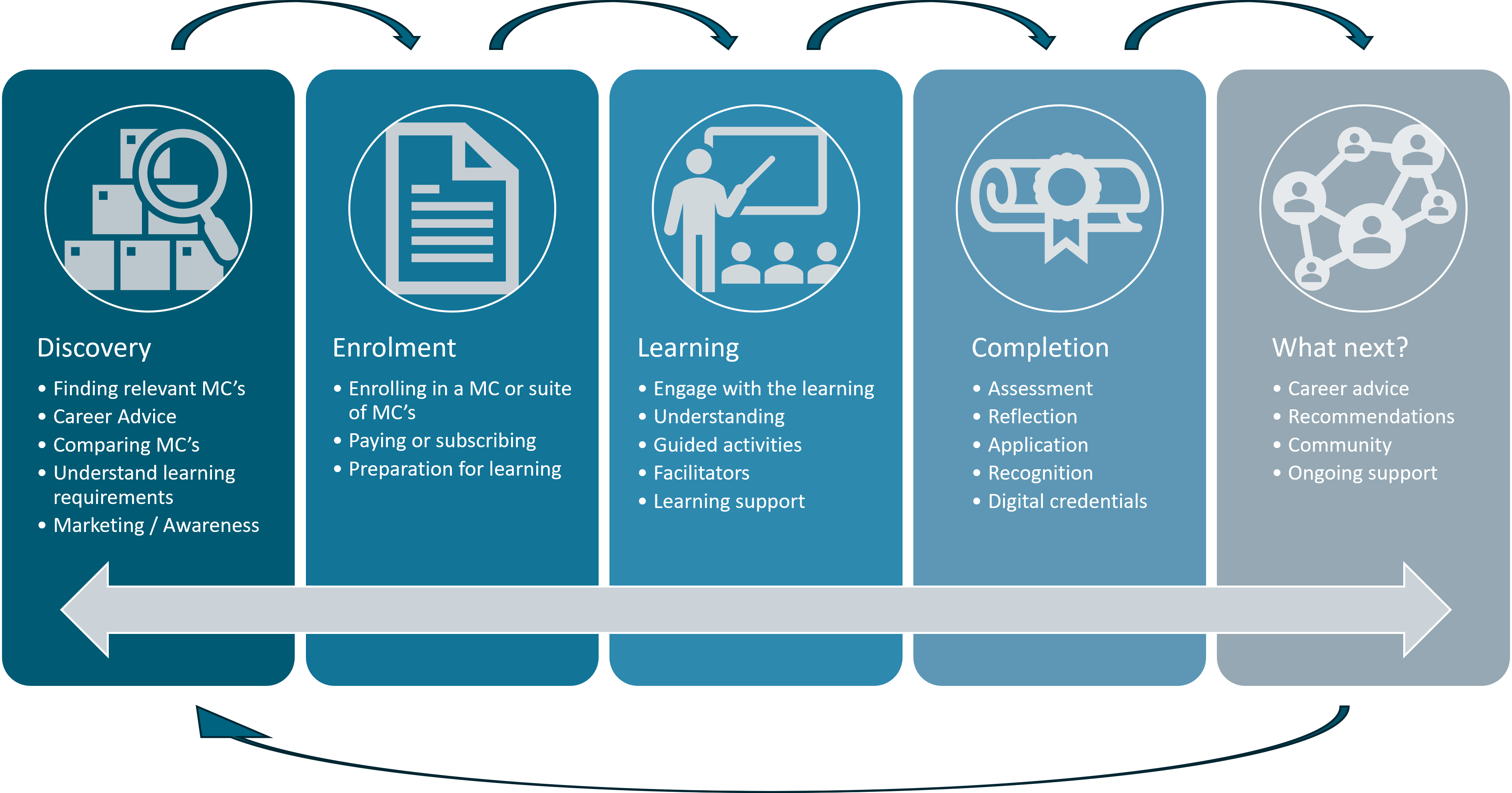
To create truly impactful microcredentials, we must carefully consider the entire learner experience, from initial discovery to post-completion opportunities. This article explores five crucial stages of this journey and provides practical ideas for optimising each phase to ensure your program delivers lasting value.
1. Discovery: Helping Learners Find Your Program
The journey begins long before a learner clicks "enrol." In today's crowded educational marketplace, how do potential participants discover your program, and what convinces them it's worth their investment of time and resources?
Understanding your target audience is fundamental to successful discovery. Different learner segments have distinct motivations and information-seeking behaviours:
Professional learners often seek to validate skills gained through work experience or self-directed learning
Traditional students may look to supplement their degrees with practical, industry-relevant skills
Career changers frequently need targeted credentials to bridge gaps between their formal education and new career paths
Lifelong learners value opportunities to document and showcase their ongoing skill development
Your value proposition must resonate with these diverse audiences while remaining clear and distinctive. Consider these essential elements:
Making it Work:
Craft a compelling narrative that immediately communicates the value of your microcredentials complement existing qualifications
Develop detailed learner personas that reflect various educational and professional backgrounds
Create engaging preview content that showcases your teaching approach and course quality
Ensure complete transparency regarding course structure, time commitments, and investment required
Leverage data analytics to understand how learners find and interact with your program information
2. Enrolment: Streamlining the Journey from Interest to Action
The enrolment phase is critical—it's where interest transforms into commitment. A friction-filled registration process can deter even the most motivated learners. This stage demands careful attention to user experience and flexibility in meeting diverse needs.
Different learner groups often require customised enrolment options:
Working professionals may need recognition of prior learning or experience
Traditional students might seek stackable credentials that complement their degree programs
Corporate clients may need batch registration capabilities and specialised billing arrangements
Individual learners might benefit from flexible payment plans or early-bird discounts
International students require clear information about time zones and technology requirements
Making it work:
Design an intuitive, mobile-friendly registration process that minimises clicks and form fields
Implement welcome processes that connect with the learner, build excitement and prepare learners for success
Offer multiple payment options and flexible start dates to accommodate different circumstances
Provide clear pre-course information, including technology requirements and preparation materials
Consider implementing a "cooling-off" period with money-back guarantees to build trust
Develop clear pathways for recognising prior learning and experience
3. Learning: Creating Engaging and Effective Educational Experiences
The learning experience forms the heart of your microcredential program. Success here requires more than just delivering content—it's about creating an environment where learners can validate and build upon their existing knowledge while acquiring new skills.
Modern learning experiences should be:
Flexible enough to accommodate different learning preferences and schedules
Interactive and engaging, promoting active rather than passive learning
Connected to real-world applications and current industry practices
Supported by robust technology and responsive support systems
Making it Work:
Implement a thoughtful blend of synchronous and asynchronous learning opportunities
Design content in digestible modules that align with adult learning principles
Include regular checkpoints and progress indicators to maintain motivation
Create opportunities for peer learning and community building
Provide multiple channels for support, including technical assistance and study guidance
Incorporate industry examples and case studies to demonstrate practical applications
Build bridges between theoretical knowledge and practical skills
4. Completion: Validating and Celebrating Achievement
Assessment and certification represent crucial components of any microcredential program. The goal is to verify learning outcomes while providing learners with tangible evidence of their accomplishments. This stage must balance rigor with relevance, ensuring that assessments truly reflect real-world skills and competencies.
Making it Work:
Design authentic assessments that mirror workplace challenges and scenarios
Provide detailed marking guides and examples to support learner success
Incorporate peer and industry expert feedback when appropriate
Issue digital credentials that are both portable and information-rich
Implement secure verification systems that maintain credential integrity
Use recognised standards and skills frameworks to enable credential verification
5. What's Next: Creating Lasting Value and Impact
The completion of a microcredential should mark the beginning of new opportunities rather than an endpoint. Success in this final stage means creating clear pathways for learners to leverage their achievements for career advancement, further education, or personal growth.
Making it Work:
Where appropriate develop clear articulation agreements with educational institutions
Create partnerships with industry associations for professional recognition
Build active alumni networks that provide ongoing value and connections
Implement regular follow-up surveys to track long-term impact
Use data analytics to identify and promote successful career pathways
Maintain engagement through continuing education opportunities
Foster a community of practice among program graduates
Help learners articulate how their microcredentials complement their formal qualifications
Final Thoughts
Creating effective microcredentials requires a holistic approach that considers every touchpoint in the learner journey. These credentials play a vital role in bridging the gap between traditional education and real-world skill requirements, offering valuable validation for learning that occurs outside formal academic settings. Success comes from attention to detail, commitment to quality, and a genuine focus on learner outcomes. Whether you represent a university, corporate training department, volunteer organisation or independent education provider, adopting this learner-centred framework will help your program stand out in an increasingly competitive landscape.
The future of education lies in the thoughtful integration of traditional qualifications and flexible, focused learning experiences that address evolving workforce needs. Microcredentials can provide targeted, practical validation of skills and knowledge gained through alternative learning pathways allowing learners to evidence all their learning and skills. By carefully crafting each stage of the learner journey, we can create microcredentials that deliver genuine value and drive meaningful change in both education and industry.
Join the Conversation
What aspects of the learner journey resonate most with your experience? How have you seen microcredentials used in your field? Share your thoughts and insights in the comments below. Subscribe to our weekly newsletter for more information on the evolution of education and learner-led lifelong learning.
Coming Next Week: We'll take a deep dive into learning experience design, exploring innovative techniques for creating engaging and effective educational content.
I really love the way you’ve mapped the experience for learners when it comes to experiencing digital credentials. Very informative. Love to explore this further with you.