
Microcredentials That Matter
When Communities Are the Co-Creators

Recognising Community as a Key Stakeholder
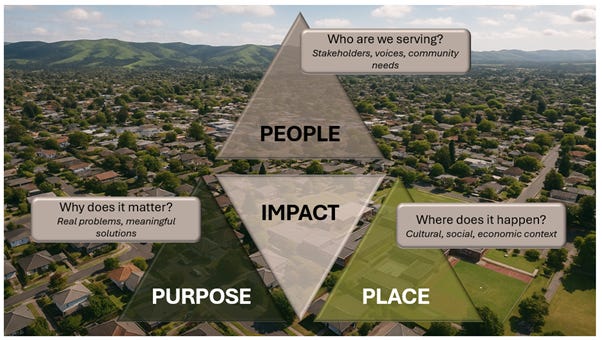
At the recent Australasian Microcredential Network (AMCN) workshop, several case studies stood out, not just because of their content, but because of who they were built for. These weren't microcredentials designed purely for employers or learners in isolation. They were created with and for specific communities, where place, purpose, and people are tightly woven together.
It got me thinking about community as a fourth stakeholder in the microcredential ecosystem. We often focus on the trio: learners, educators, and employers. But those roles don't operate in a vacuum. They're embedded in local contexts; geographic, social, economic, cultural. And in many cases, community itself becomes both the container and the catalyst for meaningful learning.
When we design microcredentials for communities, something interesting happens. They behave differently. They're not just about upskilling for the sake of it. They're about solving a real problem that people are living with every day. That might be a labour shortage, a health crisis, digital exclusion, or a cultural knowledge gap. And here's the key difference: the solution isn't dictated by an institution - it's co-created with the people most affected by the problem.
Designing Microcredentials to Address Community Needs
Microcredentials developed to solve community-specific problems look and feel different from traditional upskilling programs. They emerge from genuine consultation with all stakeholders, particularly those whose voices are often missing from educational planning conversations. This collaborative approach ensures that microcredentials become more than just educational tools - they transform into instruments for social and economic development that actually make sense in people's lived reality.
Case Studies Illustrating Community-Centric Microcredentials
Let me share some examples that show what this looks like in practice:
Bradfield City Centre, Western Sydney
The Bradfield City Centre represents a fascinating experiment in community-centered development. As Australia's first major smart city in over a century, this 114-hectare project adjacent to Western Sydney International Airport isn't just about buildings and infrastructure. It's designed to become a genuine hub of sustainability, advanced manufacturing, and innovation, with smart infrastructure and extensive green spaces supporting net-zero aspirations. What makes it relevant here is how the development prioritises creating high-value jobs while fostering a truly connected community, recognising that economic development and social cohesion go hand in hand.
GROEI Education, Regional Australia
GROEI Education tackles a challenge many regional communities know well: the gap between what young people learn and what local businesses actually need. They're using digital credentials to create clear, future-focused pathways that make sense for both sides of the equation. Their industry-endorsed, stackable microcredentials provide verifiable evidence of skills, making talent visible and transferable while ensuring young people are genuinely work-ready. It's a practical response to the reality that rural and regional areas can't always rely on traditional educational pathways to meet their workforce needs.
Curtin University's Indigenous Ranger Program, Western Australia
This program represents something profound: the formal recognition of deep environmental knowledge that Aboriginal communities have held for thousands of years. Curtin University, working alongside Indigenous-led organisations, is developing an ecosystem of microcredentials to support a new Undergraduate Certificate in Land, Sea, and River First Nation Ranger Management and Practice. What's remarkable is that this approach offers recognition and progression without removing learning from its cultural and ecological context, honouring both traditional knowledge and contemporary needs.
Digital Natives Academy, Rotorua, New Zealand
Digital Natives Academy focuses on empowering Māori youth through digital and creative technology education. By offering programs in coding, robotics, and digital wellbeing, the academy creates microcredentials that are both culturally responsive and aligned with industry demands. This initiative helps bridge the digital divide while fostering local talent development in ways that make sense for young Māori people and their communities. It's about access, but it's also about cultural identity and pride.
Sioux Lookout First Nations Health Authority, Ontario, Canada
The Sioux Lookout First Nations Health Authority (SLFNHA) serves 33 First Nation communities across northwestern Ontario, championing locally driven approaches to health and wellbeing. Their work demonstrates how traditional knowledge and practices can be woven into community-led health initiatives, ensuring services reflect Anishinabe values while meeting contemporary health challenges.
A standout example is their Community Health Worker Diabetes Project, delivered in partnership with Dignitas International. By training and employing local health workers, SLFNHA ensures that both the learning and the care remain grounded in community context. These programs show how credentialed learning can support not only workforce development, but also equity, self-determination, and improved health outcomes for remote Indigenous communities. The learning happens where it's needed most, delivered by people who understand the context intimately.
Advancing Access and Equity Through Community Engagement
What sets these programs apart isn't just their content or delivery methods - it's their intent. These microcredentials emerge from genuine consultation with all stakeholders, including the often-overlooked voice of the community itself. And that fundamental shift makes them less about compliance and more about contribution.
They also change our expectations around what success looks like. These microcredentials might not always lead to formal credit or traditional upward mobility. Sometimes, they lead to local leadership, cultural sustainability, or healthier ecosystems. And sometimes they disappear entirely - because the problem they were designed to address has evolved or been solved. That's success too, just measured differently.
Community as a Central Stakeholder
When we position community as a central stakeholder, we begin to see microcredentials not just as educational tools, but as instruments of equity and social change. They can bridge gaps in access, amplify voices that have been underrepresented in traditional educational settings, and respond to needs that mainstream education has often overlooked. Most importantly, they remind us that meaningful education doesn't only happen in institutions - it happens in places, between people, for reasons that aren't always captured in formal learning outcomes.
Recognising community as a central stakeholder in microcredential development transforms these educational tools into genuine catalysts for social and economic change. By engaging authentically with communities to identify their unique challenges and co-creating solutions together, microcredentials can foster more equitable and effective learning outcomes that actually matter to people's lives.
So maybe the most important question we can ask when designing microcredentials isn't "What should this teach?" but "Who is this for, and what do they need right now?" If the answer includes the authentic voice of a community, not just consultation but genuine partnership, then we're already doing something different. And something powerful.
Next week I’ll share some more thoughts from the Sydney workshop as I’m winging my way to Poland. I’m delighted to have been invited to speak at the Warsaw Microcredential Summit, and looking forward to sharing experience from Australia and learning from a great panel of international speakers.