

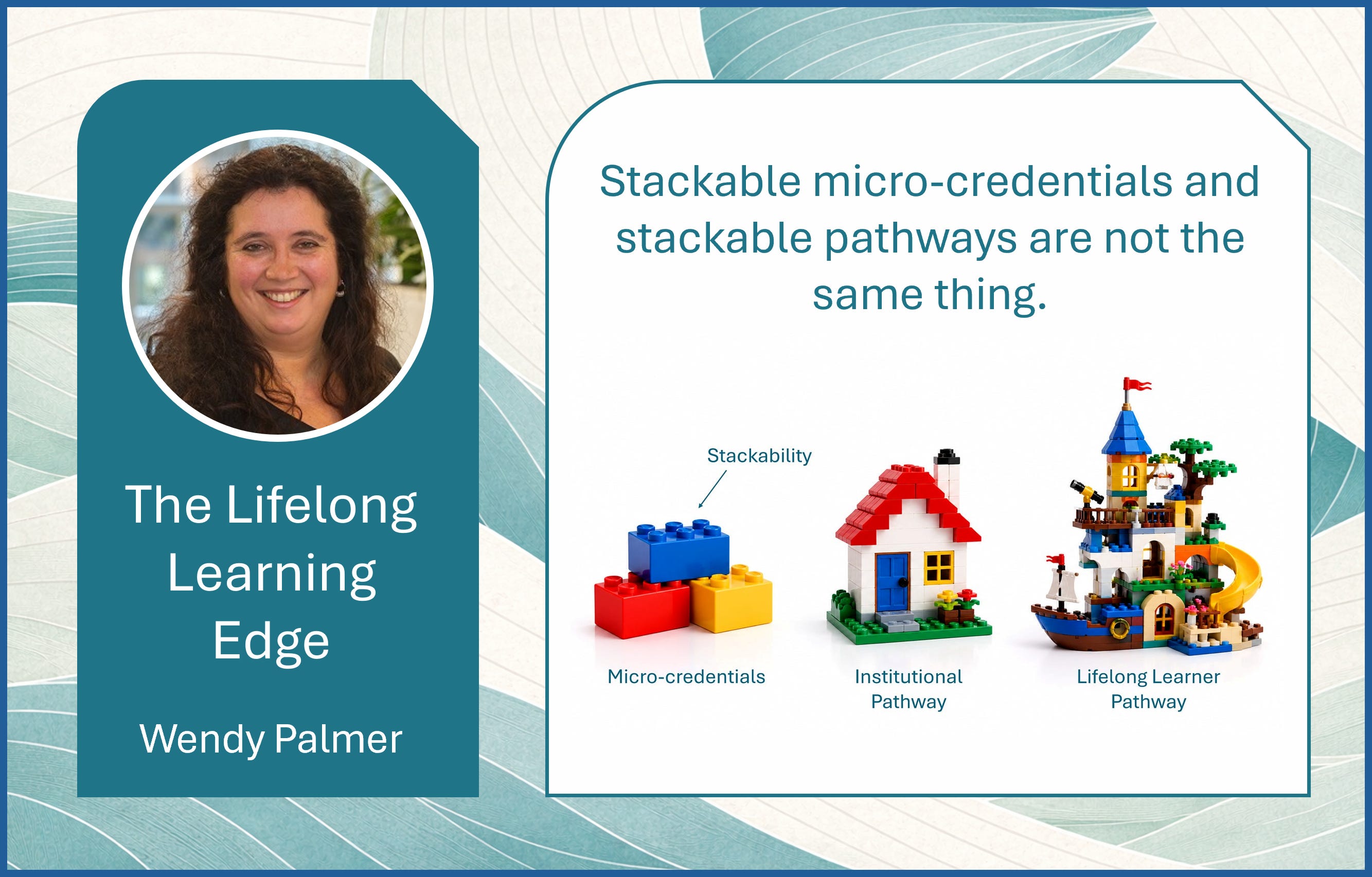
This week, while working with Mauritius on micro-credential frameworks, we were discussing stackability and stackable frameworks. When we started going into detail I was thinking that stackability as a word has travelled quickly through policy, strategy documents and conference presentations. We talk about stackable credentials, stackable pathways, stackable learning and stackable qualifications, often as though stackability is a single, settled idea.
However the more time I spend working with institutions, regulators and education systems, the more I think we need to be a little more specific. Stackability is not one thing:
there is the micro-credential itself (and not all micro-credentials can be stacked)
there are the features that allow a micro-credential to be stacked
there are institutional pathways, where providers decide how micro-credentials can be combined into a larger award or qualification
and there are learner pathways, where people collect, connect and use learning in ways that may not have been designed in advance
Those things are related, but they are not the same.
A micro-credential is a recognised unit of assessed learning. It might be credit-bearing or non-credit-bearing. It might be designed for professional learning, workforce development, community recognition, compliance, employability, entry pathways or formal study.
Stackability is different.
The Commonwealth of Learning Framework defines stackability as the feature that allows a micro-credential to be combined with other credentials for credit into higher courses or programs.
A micro-credential does not become stackable simply because it is small. It becomes stackable because it has been designed and quality assured in ways that allow it to be recognised for credit or progression.
That might include the credit value, the level, the learning outcomes, the assessment evidence, the quality assurance, the metadata, the recognition arrangements and the trust behind the credential.
A micro-credential does not have to be stackable to be valuable. Some micro-credentials are designed for immediate professional learning, workplace capability, compliance, community recognition or personal development. They may have clear outcomes, good assessment and strong value for the learner or employer without ever being intended to carry credit into a formal qualification.
When a micro-credential does have stackability features, it may not yet be part of a defined pathway. It may not have been placed into a degree, diploma or certificate and it may not be sitting in a neat diagram showing how three or four smaller pieces build into something larger.
Even so, it is inherently stackable and it has the characteristics that make stacking possible.
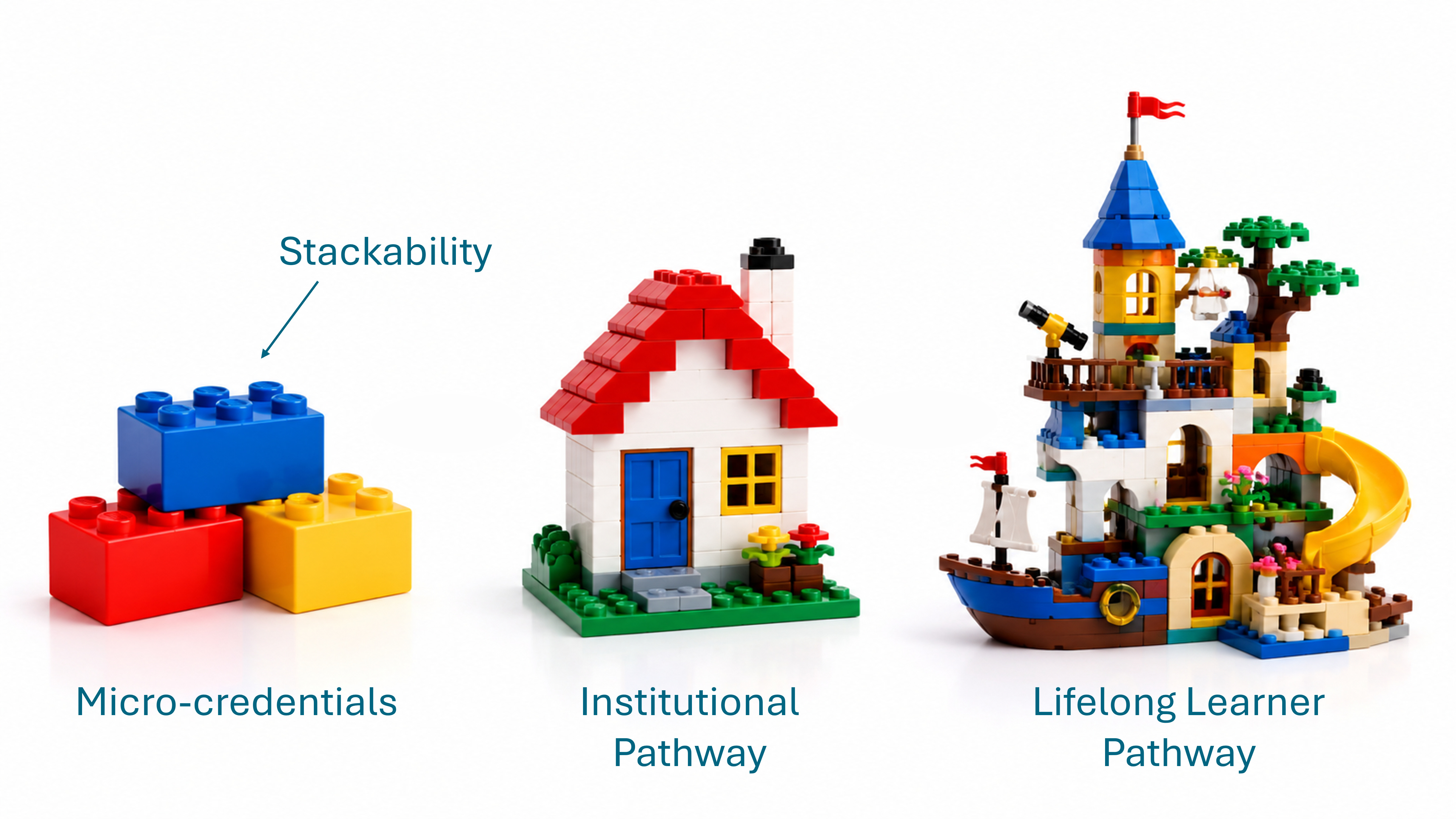
This is where Lego becomes useful.
I have used the Lego analogy before, but it has not always quite worked. It can be tempting to say that micro-credentials are like Lego blocks because they are small pieces that can be put together. That is true, but it is not the most important part of the analogy.
The thing that makes Lego work is not that the pieces are small, it is the lugs.
Those little raised circles on top of each brick are what allow one piece to connect to another. They do not tell you what to build. They do not decide whether you are making a house, a fire truck, a tower or something that exists only in the imagination of a six-year-old. They simply make connection possible.
For micro-credentials, stackability is the lugs. They are the design feature that allows the credential to connect to other learning. Without those features, the micro-credential may still be useful, but it is much harder to combine into something larger.
With those features, the micro-credential becomes capable of connection.
Not every pathway has to be designed in advance.
When you buy a Lego set, it comes in a box. The box shows you what the pieces are intended to make. It might be a boat, a fire station, a castle or a little yellow house. The instructions tell you how the pieces fit together. Someone has already designed the model. Your role is to follow the steps and build the thing on the front of the box.
That is one kind of stackable pathway.
In education, we might call this an institutional pathway. An institution decides that particular micro-credentials can combine in a particular way. It defines the rules. It decides what counts, how much credit is awarded, whether there are limits, whether the micro-credentials must be completed in a particular order, and what larger award or qualification they can contribute to.
This is important work. Institutional pathways provide clarity. They help learners understand where a micro-credential can take them. They help institutions manage academic standards and qualification requirements. They help regulators and quality assurance agencies see how smaller pieces of learning relate to recognised awards.
They are the Lego set in the box, there is a design, a pathway and a promised outcome.
A strong example of this is the MIT MicroMasters model. A learner can complete a MicroMasters program and use it as a pathway into a range of master’s degrees at different universities around the world. In that model, the micro-credential has value in its own right, but it also carries enough trust, quality and recognition to be used by other institutions as part of a formal pathway.
It shows that stackability is not only about one institution breaking its own qualification into smaller pieces. It can also support movement across institutions, systems and countries, when there is enough trust in the credential and enough clarity about how it can be recognised.
Stacking outside the box.
But anyone who has lived with Lego knows that the story does not end with the picture on the box.
At some point, all the different pieces of Lego end up in a big box. I loved playing Lego with my daughter and this is where the fun really started. A roof from one set becomes part of a spaceship. A wheel from the fire truck becomes part of a robot. A window from the little yellow house appears in a castle that was never on the box.
The pieces still work because the lugs are still there and they can connect beyond their original design.
This is the part of stackability that I think we need to pay more attention to. Learners don’t always want to follow institutional pathways. They want to create their own lifelong learner pathway.
They move between work, study, family, community, career change and personal interest. Learning happens in universities, colleges, workplaces, online platforms, professional bodies and informal settings allowing learners collect evidence of learning across time and context. Sometimes they are following a defined pathway, but often they are responding to a personal opportunity, need or disruption.
The question is not only whether an institution can stack micro-credentials into a formal award. It is also whether the learner can use those micro-credentials in more than one way, can they:
take a micro-credential completed for professional development and later use it towards further study?
bring together learning from different providers?
show an employer not only that they completed a course, but what they can actually do?
return to learning after a break and have prior learning recognised rather than starting again?
Pathways are personal
How does the system make room for pathways that were not fully imagined when the credential was first designed? This is where stackability becomes more than a curriculum design question. It becomes a recognition question. It asks whether we are designing micro-credentials as isolated fragments or as trusted pieces of a wider learning ecosystem.
Is the purpose of stackability to rebuild qualifications in smaller pieces, or to support a more flexible relationship between learning, work and recognition? Or can it be both? The institutional pathway matters. We need the model on the box, with clear, trusted ways for micro-credentials to contribute to formal awards and qualifications.
We need the big Lego tub.
But we also need systems that recognise that learners will combine learning in ways we cannot always predict. We need enough structure to create trust, and enough openness to allow movement. We need micro-credentials with the lugs built in, even when we do not yet know exactly what they will connect to. That is the promise of stackability.
Not every micro-credential must become part of a degree.
Not every learner must follow the same pathway.
Not every institution must design every possible combination in advance.
When micro-credentials are designed with the right features, they can hold value beyond the immediate learning experience. They can support institutional pathways and learner pathways. They can sit inside formal qualifications and move across a lifelong learning journey. They can help us recognise learning not as a single line from enrolment to graduation, but as something more continuous, more mobile and more connected.
Can this micro-credential stack?
This question is often where we start the conversation, perhaps we should also be asking:
What makes it stackable?
Who is doing the stacking?
What kinds of pathways are we enabling?
And how do we design the lugs so that learning can connect in ways that serve institutions, employers and, most importantly, learners themselves?
Learners need to be able to build their own Lego creations and as developers of credentials we need to enable that.