
Why Credentials need to stop being the endpoint.

I’m writing this from an airport lounge in transit. It feels oddly fitting, because that’s exactly where we are right now with learning, credentials, and skills recognition. In transit, between systems, between assumptions and in between what we’ve historically recognised and what we now need to make visible.
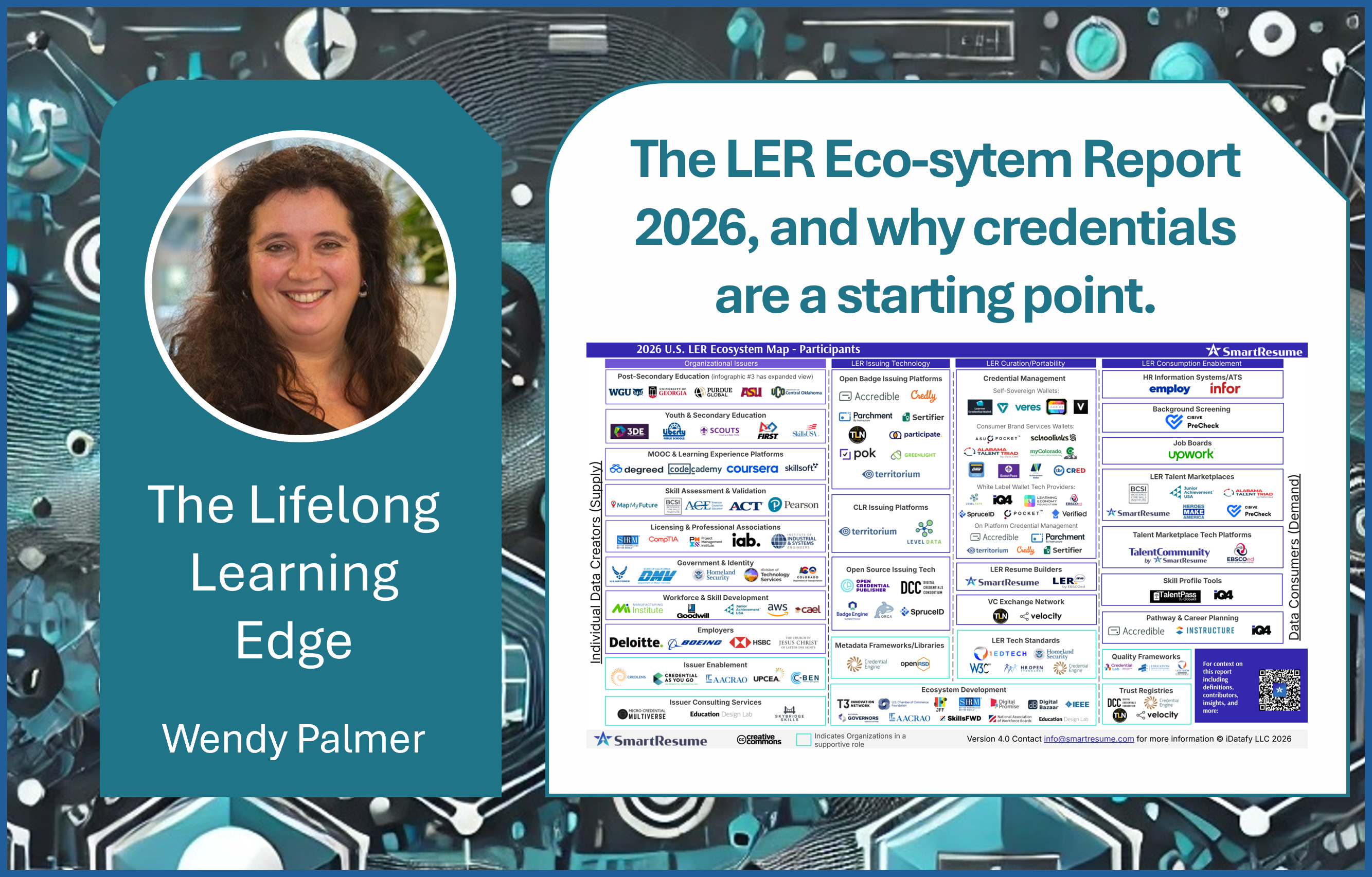
The fourth Learning and Employment Record (LER) Ecosystem Report was released last week. Each year, it connects the supply side of the system (education, training, credential issuers) with the demand side (employers, labour markets, hiring systems). What I value most is that you can see progression over time. Not perfection, but movement. Ideas maturing. Assumptions being tested. Gaps becoming harder to ignore.
I still remember the first time I read an early version of the report. It was a genuine light-bulb moment for me. I realised we were creating a product without really understanding how it would be used. We were treating the badge as the end point, when for learners, the badge is the starting point.
This year, I contributed to the report, focusing on how we move away from seeing digital credentials as end products of learning and toward using verified digital evidence to recognise skills, whether those skills are newly acquired or built up over many years.

From products to starting points
In the early days of digital credentials, it made sense to focus on the thing itself. The badge, the micro-credential, the criteria and the issuing process. That work mattered. But it was incomplete. What the LER framing helped me see is that credentials don’t exist to be issued. They exist to be used, shared and to unlock opportunity.
From a learner’s perspective, a credential is not a destination. It’s a signal they hope will help them do something next, get a job, jet a promotion, change roles, return to study, or simply be seen for what they can do. (One of the reasons many digital badges have a print option is that your parents can’t put a digital badge on the fridge)
This is where the supply–demand connection becomes critical. On the demand side, things are moving fast. AI has broken traditional hiring practices. CVs and job titles are no longer reliable proxies for capability. Employers increasingly want verified evidence, proof of what people can actually do, not just what they claim.
On the supply side, we’re facing different challenges. Many of us, particularly seasoned professionals, have deep, durable skills built over years or decades. But we don’t have those skills captured as verified, portable evidence. The capability is there. The signal often isn’t.
This is the area we’re heading into fast: recognition of skills at scale. Not just issuing more credentials, but figuring out how we surface, translate, and trust learning that already exists, across work, volunteering, community contribution, and lived experience. RPL at scale, but not for academic credit, simply to be able to participate in a world where verified digital evidence is becoming increasingly important.
The LER ecosystem doesn’t magically solve this. But it gives us the infrastructure thinking we need to even attempt it.
A lesson from Badgistan
At last year’s ePIC Conference, Julie Keane and I took part in a fictional policy challenge: solving the economic and social problems of Badgistan.
It was playful. And it was revealing. Our proposal centred on a universal Learning and Employment Record, not as a judgement of performance, but as a factual attestation of participation.
“Yes, you worked here.”
“Yes, you studied here.”
“Yes, you contributed.”
The idea was simple and moved the credentialling dial a little. Recognition starts with acknowledgement, not assessment. Individuals hold and curate their own records. Identity persists across life, not institutions. Aggregated data helps policymakers see where skills actually sit, without stripping people of agency or privacy.
What became clear very quickly as we worked on the scenario was that you cannot credential your way out of a systemic problem by focusing only on supply.
You can issue badges all day long, but if earners and employers don’t understand them, trust them, or know how to use them, nothing changes.
The real leverage points weren’t new credentials. They were:
shared language between education and employment
trusted evidence that travels
systems that help people use credentials, not just earn them
Badgistan was fictional and it was a creative activity, but the scenario we created resonated in the room, and we won the challenge, which for me reinforced this line of thinking and in the LER Report I commented,
The biggest risk to the LER ecosystem isnʼt technology — itʼs that too many people have no digital evidence to bring into it.

This week’s Who’s Badging is a little different. The Australian Institute of Sport has created a badge for its Athlete Communication and Storytelling Program, I found it on Credly. It’s a thoughtful idea, recognising skills athletes increasingly need around communication, narrative, and public presence.
The criteria are clear. What caught my eye, though, is that the organisational profile on the badge says “coming soon.” For me this raised the question, is this an initiative that didn’t fully launch, or are we simply seeing it at an early stage?
I’m not judging whenI ask that, I’m genuinely curious as it’s a useful reminder that what we put on public credentialing platforms is public.
When I first started working with MOOCs and early digital credentials, that visibility felt intimidating. Innovation is messy, and experimenting in public can feel risky. But public platforms don’t just showcase finished work. They reveal intent, priorities, and sometimes thinking still in progress.

A post by Robert Bajor, founder of the Micro-credential Multiverse captured something I keep circling back to. He framed the skills conversation around three simple questions:
Learners ask: Will this help me?
Employers ask: What does this mean?
Institutions ask: How do we structure this?
Individually, each question is reasonable. Together, they explain why so many skills initiatives struggle.
Each time we create a credential, we should be able to answer all three, from each stakeholder’s point of view (and if we can get those stakeholders in the room even better). If we can’t provide a credible answer for each questions, we need to keep working until we can.
Clear signals don’t just improve systems. They reduce friction. They make opportunity easier to navigate.
Closing
A few things coming up for me that connect directly to these questions of evidence, infrastructure, and recognition:
The Badge Sandpit is a hands-on space to explore how credentials are designed, interpreted, and actually used. There are challenges from a dozen EdTech players so jump in and have a play in the sandpit. The Badge Sandpit
I’m heading to Mauritius for a workshop on micro-credentials, and I’m really looking forward to seeing how these ideas play out in a different national context.
And in February I will be at the Digital Credentials Summit in Philadelphia, where many of these LER, evidence, and interoperability conversations are starting to mature. If you're coming I’d love to catch up in real life.
The LER ecosystem isn’t something that happens in the future. It’s happening right now, in standards bodies, in employer pilots, in credentialing platforms. The “infrastructure era” demands not only new tools, but new clarity about why we issue credentials, who they serve, and how we signal value across systems.
When we build with purpose, and when we ask, and answer questions from each stakeholder’s perspective, we make systems more navigable, not more complex.
Thanks for reading
Wendy